


Choosing Between LSR, HTV and RTV
Most sourcing questions start here, and the honest answer is that the decision is made by part geometry and order quantity more often than by material properties. The table below is how our technical team frames it with a new customer.
| Consideration | Liquid Silicone Rubber (LSR) | Solid Silicone Rubber (HTV) | Room Temperature Vulcanising (RTV) |
|---|---|---|---|
| Filler system | Precipitated or fumed, high purity | Precipitated for compression, fumed for injection and extrusion | Usually fumed, supplied in pails or cartridges |
| Typical hardness | 20 to 70 Shore A | 30 to 80 Shore A | 10 to 40 Shore A |
| Best for | Precision parts, thin walls, high-cavity moulds, high volume | Large parts, thick sections, low to medium volume, simple tooling | Prototyping, potting, mould making, small batches |
| Tooling cost | High, tight tolerance steel moulds | Moderate, simpler moulds | Very low, often open moulds |
| Cycle time | Seconds to a minute | Minutes per cycle | Hours, ambient or heat assisted |
| Typical MOQ | Higher, driven by mould cost | Lower, workable from 200 kg | Lowest, from 20 kg |
Precipitated versus fumed filler
Precipitated silica costs less and gives good mechanical strength, which is why it dominates compression moulded parts where the price per kilogram is the deciding factor. Fumed silica costs more and delivers higher tear strength, better transparency and a smoother surface. For injection moulding, extrusion and anything transparent, fumed is the correct starting point.
Platinum versus peroxide cure
Platinum addition cure gives faster cure, no peroxide by-products, better compression set and food-contact suitability, and it is what we use across LSR and the textile ink range. Peroxide cure still has a place in some general purpose HTV grades where cost dominates and the application does not involve taste, odour or skin contact. Mixing the two systems in one factory is possible, but the cure lines must be kept apart.
What You Can Customise
Hardness and mechanical properties
We compound from 20 to 70 Shore A in LSR and 30 to 80 Shore A in HTV, in two-point increments where the application needs it. Beyond hardness we adjust tear strength, elongation, compression set and rebound, which is usually what actually decides whether a part survives real use.
Transparency, colour and pigment
Transparent, translucent, natural and custom colours matched to a Pantone reference. Pigment paste is supplied alongside the compound or the ink, screened for the compliance level of the end use, so a food-contact part does not receive an industrial pigment system.
Cure speed and processing window
Fast-cure grades shorten cycle time on high-cavity moulds. Non-post-cure grades remove the secondary vulcanisation step. Longer pot life helps where manual mixing or long feed lines are involved. Each change trades against something else, and we will state the trade before you commit to a mould.
Adhesion and substrate compatibility
Self-bonding grades eliminate primer on substrates such as glass-filled nylon, stainless steel, aluminium and polysulfone. For textile inks we match adhesion to cotton, polyester blends, nylon, mesh, leather and elastic tape. Adhesion is a system question, so we ask for the substrate before quoting the ink.
Packaging, labelling and documentation
20 kg pails, 200 kg drums, or paired A and B sets in matched 1:1 ratio. Labels in your language, COA per lot, MSDS and regulatory statements issued against the grade rather than against the order.
How Our Material Is Made
Step 1. Raw material selection
Base polymer, filler grade and additive package are selected against the end application, not against a stock list. Filler choice alone sets hardness ceiling, transparency and tear strength before any other decision is made.
Step 2. Compounding and dispersion
Gum, filler and additives are compounded under controlled temperature and shear. Dispersion quality decides whether the material cures evenly, and poor dispersion shows up much later as hard spots or hardness drift across a production run.
Step 3. Filtration
Undispersed particles and contamination are removed by filtration. This step is invisible until it is not: one dark speck scraps a transparent part, and one hard particle damages a mould cavity.
Step 4. Catalyst addition and component splitting
Platinum catalyst, inhibitor and crosslinker are added, and the material is split into matched components. Dispersion control here sets the cure profile your line will live with for the life of the grade.
Step 5. Vacuum deaeration
Entrained air is removed under vacuum before packing. Air becomes bubbles in the finished part, and bubbles are a visible defect in transparent and thin-wall products.
Step 6. Lot testing and release
Hardness, density, tensile strength, elongation, tear strength and volatile content are tested per lot, with light transmittance and adhesion added where the grade requires it. Material is released only after the lot passes and the certificate of analysis is issued.
Step 7. Packing and traceability
Packed in pails or drums labelled with grade, lot number and production date, with retention samples archived so any field issue can be traced to a production run.
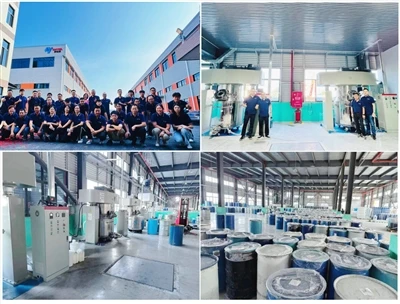


Products


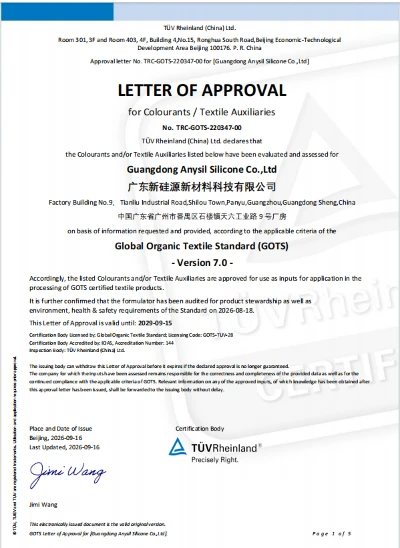
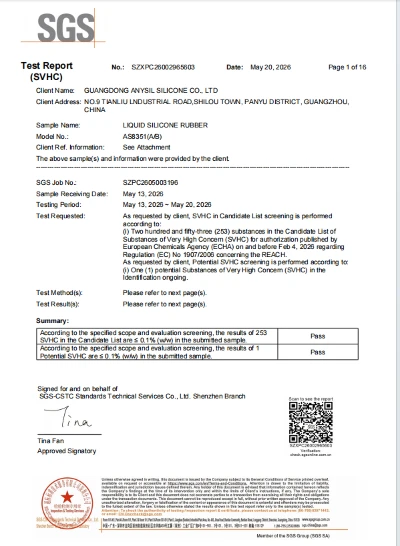
Certifications and Compliance
ISO 9001. Quality management system covering compounding, testing and release across all six product families.
Food contact. FDA 21 CFR 177.2600 for the United States, German LFGB and Council of Europe Resolution AP(2004)5 for Europe. For silicones the European reference is AP(2004)5 plus national rules, not EU 10/2011, which governs plastics.
Medical. ISO 10993 biocompatibility testing and USP Class VI available for medical grades, with documentation issued per grade.
Textile. OEKO-TEX and ZDHC documentation for the silicone ink and coating range, where the end customer's programme requires it.
REACH, SVHC and RoHS. Registration status and declarations per grade, updated as the candidate list is revised.


How to Start
Step 1. Tell us the application and the process
What the part does, which process will run it, the substrate if there is one, target hardness, colour, annual volume and the certification list your market requires. One page is enough.
Step 2. Material recommendation
We propose a grade or a modification, with the technical data sheet and the compliance documents for that grade, and we flag the trade-offs rather than presenting one option as universal.
Step 3. Free sample
Sample ships within seven working days, typically 5 kg per component for LSR, 5 to 10 kg for HTV. You pay freight only.
Step 4. Trial and adjustment
You run the trial, we review the result with you and adjust formulation if needed. Most projects close in one or two rounds, and the adjustments are recorded against your part number.
Step 5. Production supply
Formulation locked to your part number, supply against forecast, COA and lot traceability on every shipment.
What Our Customers Say
"We print silicone on performance apparel and we were buying ink from one supplier and pigment from another. The colour drift between them was costing us reprints. Sourcing both from ANYSIL removed that variable, and the adhesion on polyester blends held through our wash testing."
Production Manager, garment decoration company, Vietnam
"Our catheter components need consistent hardness and no yellowing after sterilisation. Four years of supply and the lot to lot variation has stayed inside our incoming inspection limits, which is the only thing we actually care about."
Quality Manager, medical device manufacturer, Poland
"We run compression moulding and needed a compound that also worked in injection for a smaller part. The ASH7050 series let us keep one material in stock instead of two, and the technical team explained which settings had to change."
Owner, industrial rubber moulding factory, Turkey
Frequently Asked Questions
Should I use liquid silicone rubber or solid silicone rubber?
The decision is usually made by geometry and volume. LSR suits precision parts, thin walls, high cavity counts and large volumes, and it justifies the tighter mould because cycle time is measured in seconds. HTV suits larger or thicker parts, lower volumes and simpler tooling, where a mould that costs a fraction of an LSR tool still makes commercial sense. If you send the drawing and the annual quantity, we will tell you which route the numbers support.
Can one supplier really cover both moulding compounds and printing inks?
At Anysil, yes, and it is the reason many customers consolidate with us. The moulding families and the ink families are made in the same plant under the same quality system, so a product that needs a moulded silicone body with a printed silicone surface can be specified as one package. You get one compliance file, one batch traceability chain and one technical contact instead of two.
What is the difference between precipitated and fumed silicone?
Both use silica as the reinforcing filler, and the production method of that silica changes the economics and the properties. Precipitated silica is cheaper and gives good strength, which suits compression moulded parts where price per kilogram decides. Fumed silica costs more and delivers higher tear strength, better transparency and smoother surfaces, which is why injection moulding, extrusion and clear parts start from fumed grades.
Do you supply food-grade and medical-grade materials?
Yes, across LSR, HTV and the ink range. Food contact grades are documented against FDA 21 CFR 177.2600, German LFGB and Council of Europe AP(2004)5. Medical grades carry ISO 10993 biocompatibility and USP Class VI documentation, issued per grade rather than as a blanket company statement. Tell us the contact duration and the sterilisation method, because those two answers determine which grade is appropriate.
What is your minimum order across the different families?
Sampling starts small, typically 5 kg per component for LSR and 5 to 10 kg for HTV, with freight only. Production orders generally start from 200 kg per grade. Silicone ink orders can start lower because the application rate per garment is small. Custom formulations add one to two weeks for lab work, and the MOQ is quoted with the formulation rather than as a fixed company rule.
Can you match a colour and supply the pigment with the material?
Yes. We match to a Pantone reference and supply pigment paste alongside the compound or ink, screened for the compliance level of the end use. For transparent parts we quote light transmittance and yellowing behaviour after sterilisation, and for textile work we test the colour after the customer's wash cycle, because wash fastness is where colour matching usually fails.